


Behind a product used by 80% of Fortune 500 companies is a partnership that started in 2012, when the product was just a prototype. What follows is the account of how that partnership grew alongside the product – and how it held together through the biggest change in the company’s history.
Sections in this article:
A long term partner moves into next chapter | How the partnership was built | The bootstrapped bet | Organic growth, product first | Clarity platform and enterprise scale | How the partnership evolves
Partnership at a glance
| Partner | Lucen Software (formerly Office Timeline) |
| Headquartered | USA |
| Partnership start | 2012 |
| Duration | 14 years, ongoing |
| Market reach | ~ 80% of Fortune 500; pharma, engineering, IT, professional services, government |
| Products delivered | Lucen Timeline, Timeline Online, Flowchart (beta), Plan (beta) |
| Team functions | Engineering, QA, design, marketing, customer support |
These figures capture where the partnership stands today. What follows shows how we got here:
A long term partner moves into its next chapter
Some partnerships run their course when a product ships or a contract ends. Others accumulate something harder to replicate – shared context, product history, institutional knowledge – the kind of continuity that becomes valuable exactly when things change.
Office Timeline – the US-based productivity software company behind one of the most widely adopted timeline tools for Microsoft PowerPoint – is in the middle of that kind of change. In May 2026, after more than a decade of building products together, the company completed a change of ownership, a new business development strategy, and relaunched under a new name: Lucen Software.
The rebranding is not cosmetic. Lucen represents a shift in scope and ambition: from a focused productivity add-in to what the company describes as a clarity platform – a Microsoft-native suite designed to help enterprise teams convert fragmented information into shared understanding. The product lineup has expanded accordingly, now including alongside Timeline Add-In and Timeline Online – the newly added Plan, Flowchart, and Track – forming a connected suite rather than a standalone tool.
Omair Sarwar frames the new vision:
“The name change is a public commitment to one thesis: that the most valuable thing our solutions can do in 2026 isn’t to help people work harder or faster. It’s to help people get alignment, make decisions, and apply human judgment.” Omair Sarwar – CEO Lucen Software |
RomSoft has been part of this story since 2012 – through the product’s early stages, its organic growth, and the new mission for clarity. What follows is an account of how that partnership was built, how it grew, and where it is headed.
How the partnership was built
The 14-year arc of the RomSoft – Lucen partnership can be followed in three distinct phases, each shaped by where the product was and what it needed.
The bootstrapped bet (2012)
Office Timeline launched as a self-funded startup. The founding team had a prototyped PowerPoint add-in and a clear problem to solve. Project managers were spending hours manually formatting timelines that should take minutes. What they did not have was venture capital or the runway to make large upfront commitments.
The decision to partner with RomSoft was driven by two factors. First, technical depth – the founders needed engineers who could take a prototype to a production-ready level. Second, commercial flexibility – the engagement had to be structured in a way that allowed the relationship to start small and scale as revenue grew, rather than requiring a commitment the company couldn’t yet afford.
That structure defined the tone of the partnership from the start: shared interest in the product’s success, not fixed-scope delivery.
Organic growth, product-first (2013-2024)
As the product found its market and the user base grew, the partnership evolved in a direction that wasn’t part of the original plan. The initial scope was engineering. Over time, the embedded RomSoft team expanded to include QA, design, marketing, sales, and customer support.
The logic behind that expansion was straightforward. The product was scaling, and adding new functions required either building new relationships from scratch or extending an existing one that was already working. The quality and reliability of the RomSoft team – and the accumulated product context – made horizontal expansion the lower-risk, more efficient path.
The result was an embedded partner rather than a supplier: a team that understood the product from the inside and could take ownership across multiple functions without requiring constant direction.
By the time the flagship product – Timeline Add-In – reached maturity, the RomSoft team contributed to the full product lifecycle.
Products built together
The Timeline Add-In and the Timeline Online version are the two products that defined the first decade of the partnership – and the foundation on which the Lucen suite is built today. Together, we continue to develop these products by adding new features and refining existing ones.
Timeline Add-In
Released 2014
Phase 1 – Bootstrapped Bet
Problem solved
Project managers using PowerPoint had no native way to create professional timelines and Gantt charts quickly. Existing tools produced visuals that were either too complex to generate or too plain to present to executives and stakeholders. The add-in brought timeline creation directly into PowerPoint, reducing a multi-hour task to minutes.
Tech stack
Azure technologies (Azure Insights, App Services, Azure Storage, Azure Functions)
Details
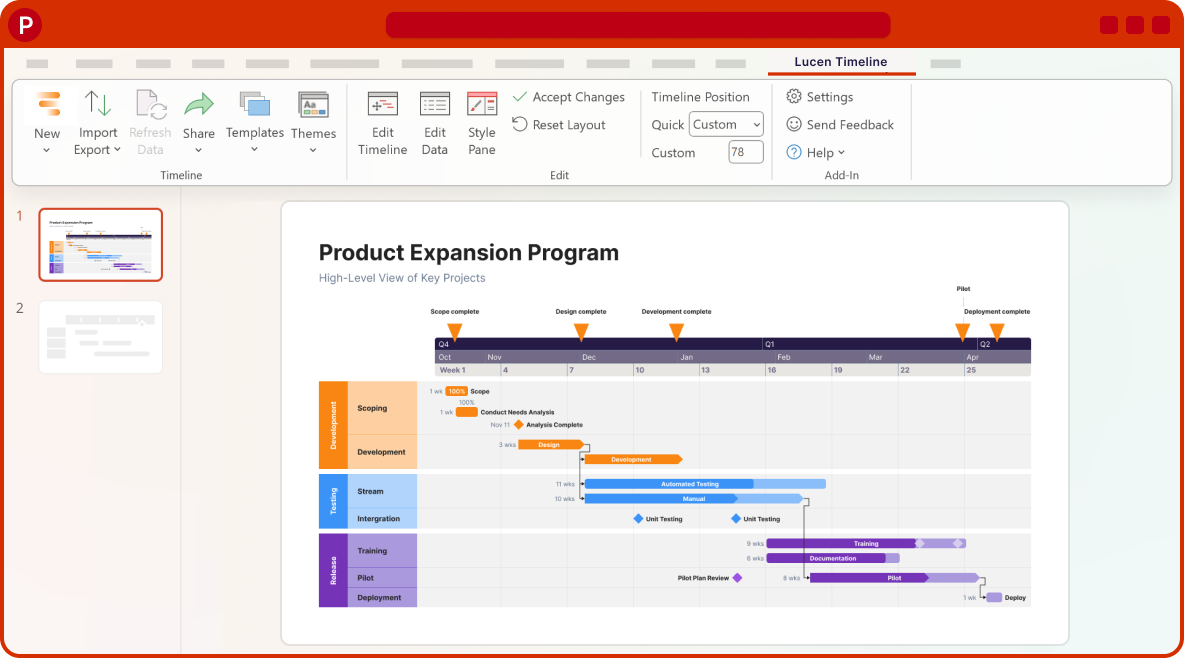
Screenshot: Lucen Timeline Add-in in PowerPoint
Timeline Online
Released 2018
Phase 2 – Organic Growth
Problem solved
The PowerPoint add-in required a Windows installation, which excluded Mac users and professionals with restricted IT permissions – a growing segment of the market. Timeline Online brought the same functionality to the browser: no installation, accessible from any OS, with added collaboration features including shareable view-only links and task assignment.
Tech stack
C#, JavaScript, .NET Core 3.1, Ember.js, ASP.NET Core, Azure Services (Azure App Services, Azure Storage, Azure Function Apps)
Details
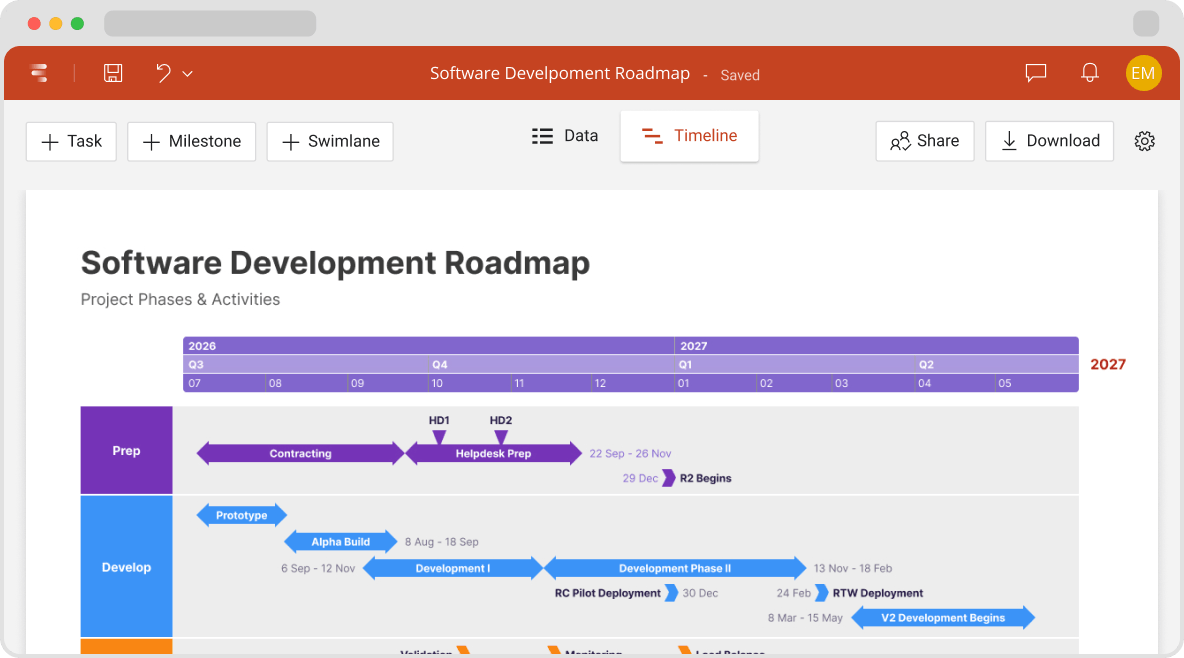
Screenshot: Lucen Timeline Online
Lucen Software: clarity platform and enterprise scale (2024 – today)
The most recent phase of the partnership coincides with the broader transformation of the company itself.
The rebrand reflected the shift in scope: from a timeline tool, to what the company describes as a clarity layer for enterprise teams, a platform designed to help organizations move from fragmented information to shared understanding.
Under the Lucen brand, the product suite has expanded: Flowchart and Plan (both currently in beta) are in active development alongside the established Timeline products, with the RomSoft team contributing across all of them.
Transitions of this scale – new ownership, new leadership, new brand – typically create friction in supplier relationships. Context is lost. Priorities shift. Teams rebuild trust from scratch. That’s where the continuity provided by the RomSoft team proved its worth: 14 years of architectural history, product decisions, and accumulated understanding of the codebase and the customer meant that the transition could move forward without the typical slowdown.
| “RomSoft didn’t just support this business, they helped us build it from the ground up. Going from zero to one in 2012 was only possible because of the work they put in, and the products that carried us to 80% of the Fortune 500 have their fingerprints on every layer. Just as important is who they are: high-integrity people. So, when we went through a rebrand and ownership transition, we never worried about the business: engineering, sales, marketing, support, all of it was in great hands.” Eddy Malik – Lucen Software CPO, Co-founder Office Timeline (now Lucen) |
The partnership now enters its most technically ambitious phase – in step with the customer vision, and consistent with our way of work: understand what the partner is building; bring every available capability to make it happen.
Products built together
The next phase of the Lucen suite: in active development, two new products extending the clarity platform into planning and process visualization workflows – Plan and Flowchart.
Plan
2026 – Currently in beta
Phase 3 – Clarity Platform
Problem solved
Completes the Microsoft Productivity Suite by integrating Excel into the workflow. Helps the user add structure to their Excel spreadsheets, build Gantt charts, schedule work, and track dependencies – all without leaving Excel.
Tech stack
C#, TypeScript/JavaScript, Python, C++, SQL
.NET 9, WinUI 3, WPF, WebView2, React, FastAPI, SQLAlchemy, Docker, Azure, GitHub Actions
PostgreSQL
Details
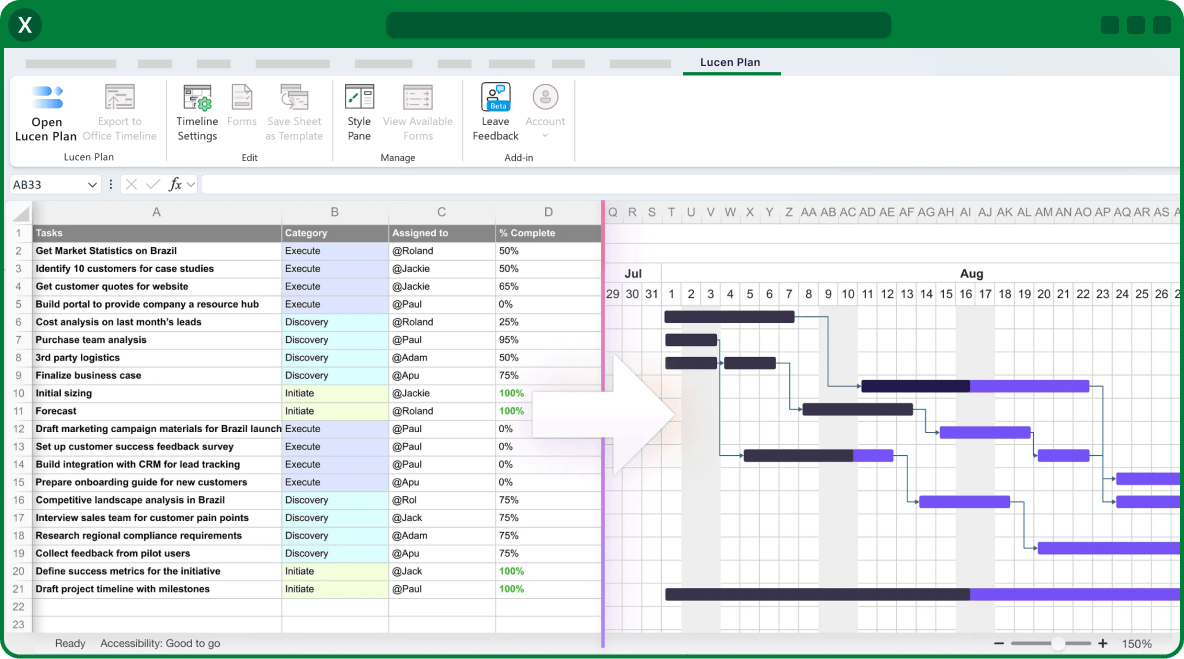
Screenshot: Lucen Plan in Excel
Flowchart
2026 – Currently in beta
Phase 3 – Clarity Platform
Problem solved
Besides timelines and Gantt charts – Flowchart introduces process mapping inside PowerPoint. Most teams build flowcharts outside PowerPoint, then bring them back in. Flowchart eliminates this step, helping users plan, refine, and share processes with precision – without switching tools or rebuilding diagrams.
Tech stack
C#, TypeScript/JavaScript, Python, C++, SQL
.NET 9, WinUI 3, WPF, WebView2, React, FastAPI, SQLAlchemy, Docker, Azure, GitHub Actions
PostgreSQL
Details
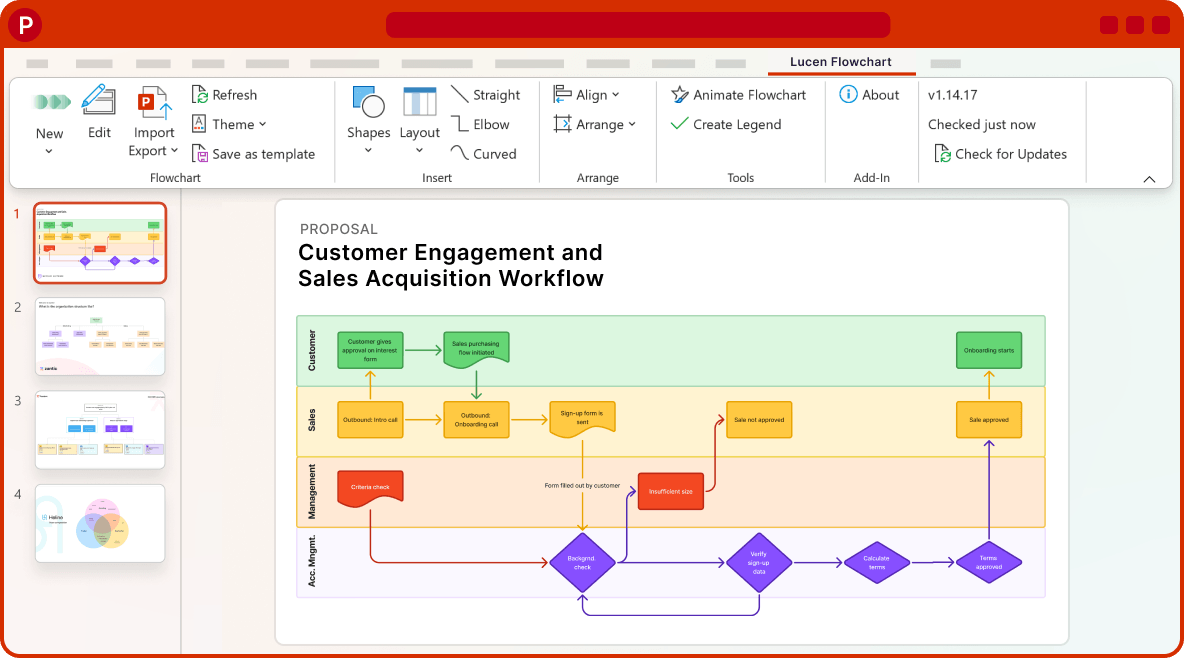
Screenshot: Lucen Flowchart Add-in in PowerPoint
How the partnership evolves
The way the RomSoft team operates on the Lucen partnership today is different from a conventional software development engagement – and different from how it operated in the partnership’s earlier phases.
The difference is not in the volume of delivery, but rather in the method. As Lucen has moved into a broader, more complex product suite, the engineering challenge has shifted: fewer problems have obvious solutions. More of the work involves evaluating options, testing approaches early, and making informed architectural decisions under uncertainty.
The team has organized around a research-oriented model. Rather than moving directly from specification to implementation, the team dedicates structured capacity to exploration: defining the problem space, identifying candidate solutions, building and evaluating prototypes, and establishing which directions are worth pursuing before committing to full development.
This shift toward research and exploration coincides with a broader change in how the team approaches tooling. AI-assisted development practices are now integrated into the day-to-day workflow – not as supplementary tools, but as active components of how problems are approached and solutions are built.
This model – research-oriented, AI-integrated, tool-agnostic – fits the context of what Lucen is building. A clarity platform for enterprise teams requires solving problems that do not yet have established playbooks. The team working on it needs to be able to move quickly into new territory, evaluate options honestly, and build with the best tools available at the time.
To conclude, the partnership with Lucen Software is atypical, in the way it didn’t start with a formal RFP – but with two founders willing to bet the technical depth is there, and a team willing to earn it over years. We welcomed the opportunity – and the years since have shown that bet was well placed.
Looking for a development partner?If this story resonates with what you’re looking for – a team that integrates deeply, delivers consistently, and stays for the long haul – we’d like to hear about your project. |