


A colleague at our tech company once asked me to prove that storytelling works. Here goes:
The Challenge
Storytelling has been having a moment in recent years, starting with the creative industries but slowly extending into the technical side, too. However, I’m still seeing issues with how it’s being perceived: more as a nice-to-have and less of a must-have.
It shouldn’t be a surprise that when I first started talking to our IT colleagues about storytelling, they looked at me with squinted eyes. Telling stories did not find a place in an environment filled with code, numbers, rules, and tight deadlines. Stories sounded like the soft, mushy stuff that IT people cringe at – a marketing concern at best, a distraction from their actual work at worst.
That reaction has tempered a lot over the years. Most of my colleagues are now willing to humour me when I bring up storytelling, even if they wouldn’t put a “narrative arc” in their next daily stand-up. But at one point, some time ago, one of them pushed back in a way that challenged me to see their side of the story.
He’s an analytical colleague, the kind of reader who skips straight to the bit with the answer in it, and who only follows blogs that go problem-solution-done without any of what he might call “the literary bits”.
We were talking about storytelling, including its uses in software, when he looked at me across the conference room and asked, with friendly skepticism: “But WHY do that? How does storytelling actually make a blog post better?”
I gave him my usual answer. Because our brains are wired for it. It’s easier to transmit information when it comes wrapped in a story, easier to receive it, to remember it. That’s how the human brain works.
He nodded politely, took a deep breath, and smiled gently. Then he said: “Diana, you’re going to have to prove it to me.”
I said: “OK. I can do that.”
This is that proof.
If you’re the kind of person who normally skips the story to get to the facts, this article is built for you. The facts are all here. They just happen to come with a story attached – for reasons that, by the end, I think you’ll understand.
A short detour through 100,000 years
Before I get into the brain wiring, I want to start with the part that, more than anything else, convinced me storytelling wasn’t a stylistic preference, but a built-in feature of human evolution.
The first traces of human language go back roughly 100,000 years.
The earliest known cave paintings – already an attempt to share an experience with someone who wasn’t there – are at least 51,200 years old. The 2024 Nature paper describing one of those scenes found in eastern Indonesia calls it the world’s oldest known “narrative cave art”, the first preserved record, anywhere, of one human telling another a story.
Writing as we know it shows up about 5,000 years ago.
PowerPoint, the medium most of us still use to communicate at work, is around 40 years old.
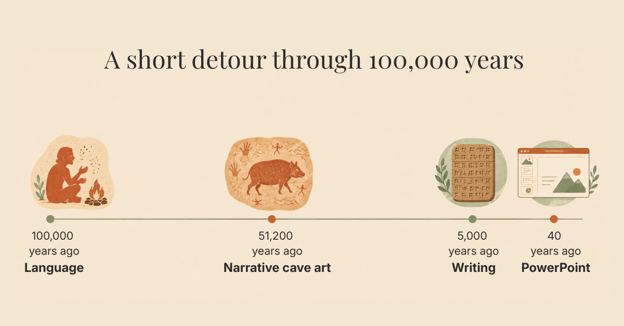
Arrange those in order and the picture becomes clear. We’ve been telling each other stories for tens of thousands of years before writing was invented, and almost a hundred thousand years before anyone built a slide deck.
On the grand scale of humanity, bullet points have been around for the last five seconds. Stories are the bed rock that predates almost everything else we use to communicate.
What happens in your brain when I tell you a story
OK. Here’s where the proof actually starts. Stick with me.
When you read a list of bullet points or a spec document, primarily two specific areas of your brain light up: Broca’s area and Wernicke’s area. These are the language-processing regions. They take symbols on a page and convert them into meaning. That’s it. That’s the whole thing. You decode the information, you store a bit of it, and you move on.
When you hear or read a story, something very different happens. Your whole brain shows up to work.
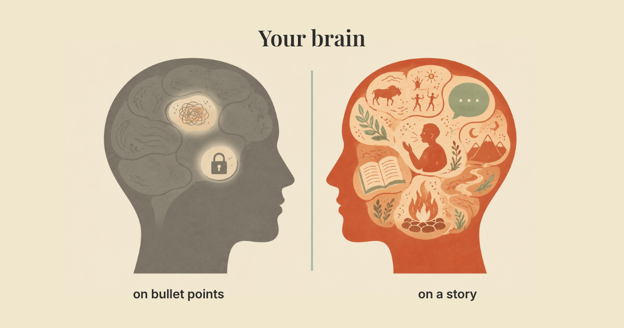
If I tell you that Patrick the project manager was running so late he forgot to finish his coffee and showed up to the meeting still half-asleep, your language areas process the words, yes. But your motor cortex also activates as if you were running. Your olfactory cortex picks up faintly on the word “coffee”. Your emotional centres quietly start to root for poor Patrick.
This isn’t a metaphor; it’s literally what’s happening in the brain on a subconscious level. Princeton neuroscientist Uri Hasson has shown that when one person tells a story and another listens, their brains begin to synchronize; the same regions activate, in the same patterns, at roughly the same time. The technical name is neural coupling. The plain-English version: a good story temporarily makes two brains align and experience the same thing.
What this means, in terms my colleague would appreciate: if I just tell you the facts, your brain only does language work. If I wrap the facts in a story, your brain does language work plus it half-lives the experience. It’s the same information either way. But one version is going to stick, and the other one is going to fly away like leaf in the wind.
For my analytical colleague: this is the part where I’d turn and say: “Still skeptical?”
The chemical cocktail
If you’re someone who needs measurable evidence to be convinced, here’s where you’ll find it.
Stories don’t just light up brain regions. They trigger the release of specific chemicals, ones that change how you feel, focus, and remember. Four chemicals are worth knowing:
- Cortisol is the brain’s “pay attention” chemical. It spikes when something matters: when there’s tension, a threat, a problem to solve. In a story, a well-placed setup (“Patrick had ten minutes to create a project timeline before the client meeting”) triggers cortisol. It also, as it turns out, helps the brain form memories. So the moment your reader gets a little tense is the moment they actually start remembering what you wrote.
- Dopamine is the reward chemical. It keeps you engaged. It’s why you can’t stop watching a series at 2am even though you have a meeting at 9. Stories use rising tension to drip-feed dopamine, which means readers stay focused even on dense or technical material – as long as they feel they’re somewhere along a narrative arc.
- Oxytocin is the empathy chemical. It’s released when we trust someone, when we’re shown kindness, and most importantly, when we identify with a character in a story. This is why product stories that put the user front-and-centre outperform feature lists every time. Oxytocin makes your reader feel for the hero. And once they’re feeling for the hero, anything that hero is trying to do becomes important to them.
- Endorphins are the relief-and-laughter chemical. They show up when tension breaks, when something is genuinely funny, when a long-running setup finally pays off. This is why humour works in writing for tech audiences, even though most of us were trained to keep it serious. A small endorphin hit at the right moment is the difference between “I think I read your article” and “I read your article, spit my drink laughing, and I sent it to two colleagues”.
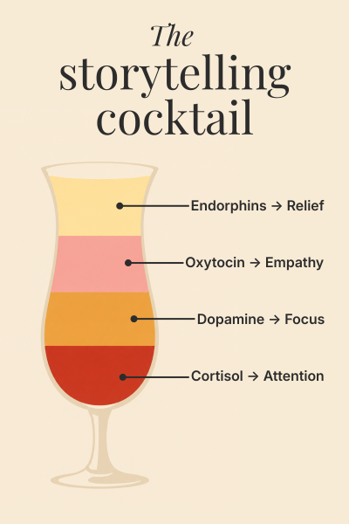
Let’s recap. Cortisol gets your reader alert and dopamine keeps them focused. Oxytocin builds empathy and makes them care about the people involved. Endorphins are what make the whole thing memorable enough to bring up at lunch the next day.
That, in four chemicals, is the entire engineering brief for a piece of communication that actually works.
“OK, but how do I use this?”
Glad you asked. You did ask, didn’t you? Even silently? Good, it’s working.
The same neuroscience that explains why stories stick also gives us a rough recipe for using them. There’s a storytelling formula I like, and it spells READ:
- Research your audience. Know who they are, how they talk, and what they actually care about. A story for a developer audience and a story for a board of directors are different versions of the same narrative.
- Establish a formula. The brain recognises stories as patterns: beginning, middle, end. The simpler the pattern, the stickier the story. Don’t be clever; be clear.
- Add details. Especially sensory ones. The reason I mentioned Patrick and his coffee a few paragraphs ago is that the word “coffee” has a strong, familiar smell attached to it, and you’ll remember the example longer.
- Deliver or Distribute. A story nobody hears might as well not exist. Publish the blog, give the talk, write the release notes, send the email.
Where does this show up in tech work? Lots of places, but I’ll just mention three obvious ones.
In learning and development, storytelling turns a dry training deck into something people actually enjoy and retain. Case studies, branching scenarios, walkthroughs – every one of those is storytelling wearing a different hat.
In UX and product design, stories are how we build empathy for users. Lots of artifacts – personas, journey maps, user stories – are narrative devices borrowed straight from fiction.
In marketing and product communication, stories are how customers see themselves inside what you’re demo-ing. If your users can picture themselves as the hero of your story, and your product as the guide who helps them win, they will, statistically, be far more likely to give you the next five minutes of their attention. And, hopefully, their money.
If you’d like a closer look at how storytelling plays out inside an Agile development cycle specifically, I wrote a piece on that recently. Call it the “how” to this article’s “why”.
Back in the office
Which brings me back to my analytical colleague.
I haven’t gone back to him with this article in hand yet. I’m slightly nervous about it, to be honest. He’s the kind of reader who really would skip ahead. But here’s what I’m hoping: even if he scrolls past most of this and lands on the four chemicals (cortisol, dopamine, oxytocin, endorphins), something in his brain is still going to do the work that storytelling does.
He’s going to remember “the coffee thing” or “the cave painting thing” longer than he’d remember a slide of bullets making the same point. He won’t be able to help it. His neurons are on my side.
That, more than anything else, is why I do this for a living. Your brain isn’t an inefficient version of a spreadsheet that grudgingly accepts stories because we haven’t invented a better delivery system yet.
It’s the other way around: stories are the format the brain was built to receive data in. Bullets are the workaround. Skipping the story to get to the facts sometimes robs you of an experience your brain would enjoy.
The novelist Terry Pratchett once wrote: “People think that stories are shaped by people. In fact, it’s the other way around.” When I first read that, it sounded so clever that I saved it in my notes. Now I know it’s also, as we’ve seen, a neuroscience claim. We are not just the only species able to tell stories. In fact, we are the species that stories have shaped.
I think my colleague will come around eventually. One story at a time.